
How Google Earth AI and Gemini are Redefining.
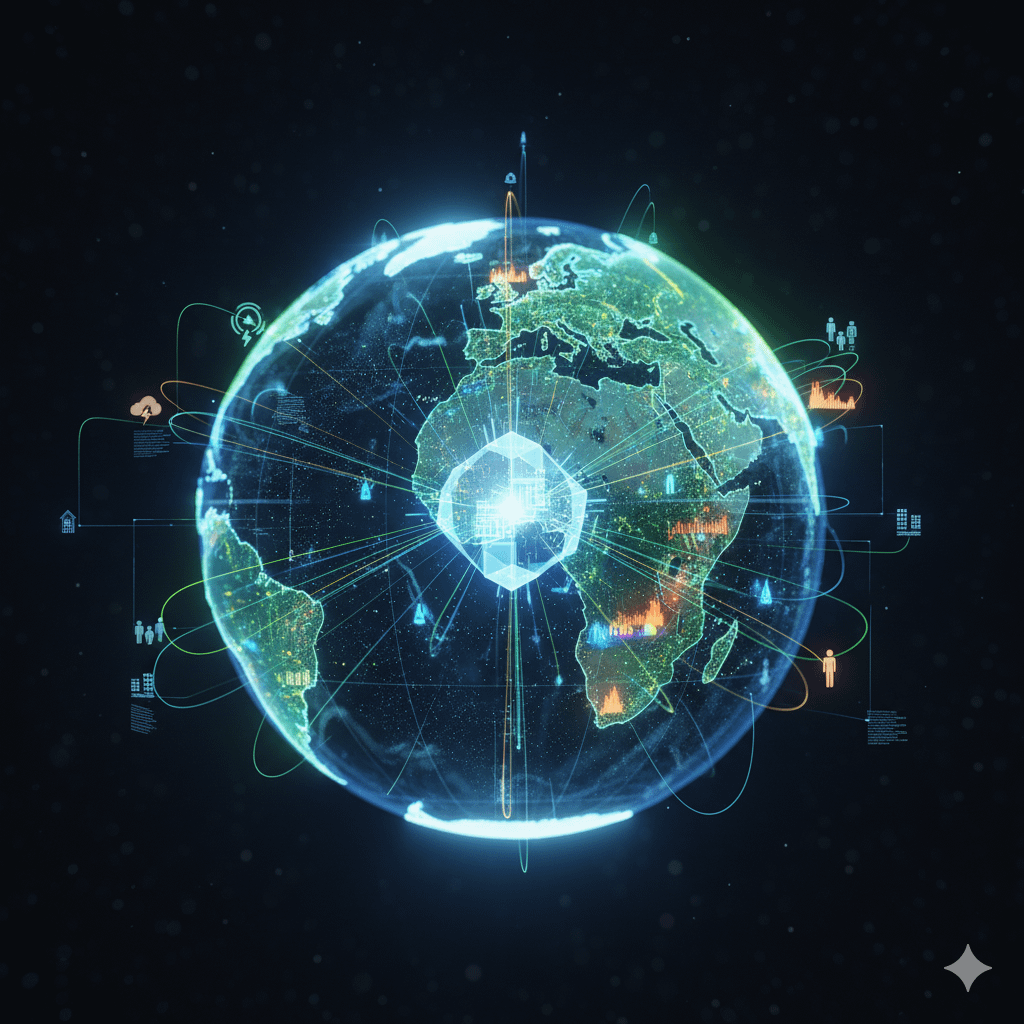
For years, analyzing the Earth at a planetary scale required highly specialized experts and weeks of manual data crunching. That era is over. Google has launched Geospatial Reasoning, a revolutionary framework powered by Gemini AI, which allows Earth AI models to think, connect data, and answer complex questions—like “Which vulnerable infrastructure is near the wildfire’s path?”—in minutes, not months. Your guide to the most significant leap in global intelligence starts now.
This is not just about better satellite imagery; it’s about transforming decades of visual data into actionable, real-world intelligence at a planetary scale. Google Earth AI is at the forefront of this revolution, promising to address some of our most urgent global challenges, from climate change to disaster preparedness.
I. What Powers Google Earth AI? The Foundational Technology
Google Earth AI is a sophisticated, multi-layered architecture that fundamentally shifts geospatial analysis from simply viewing data to generating actionable intelligence. It’s an ecosystem built on three main pillars: an immense Foundational Data catalog, specialized Earth AI models, and the orchestrating power of the Geospatial Reasoning Agent with Gemini AI.
1. From Petabytes to Patterns: The Foundational Data Lake
At its base, Google Earth AI ingests petabytes of diverse geospatial data from dozens of public sources. This isn’t just pretty pictures; it includes:
* Optical Satellite Imagery: High-resolution visual data from various providers.
* Radar Data: Crucial for seeing through clouds and measuring subtle changes on the Earth’s surface.
* 3D Laser Mapping (LiDAR): Providing precise elevation and terrain models.
* Climate Simulations & Environmental Sensors: Data on temperature, precipitation, atmospheric conditions, and more.
The challenge isn’t just collecting this data, but making sense of it. This is where AlphaEarth Foundations comes in. Developed by Google DeepMind, AlphaEarth Foundations is a crucial foundational model that processes this vast, disparate data. It assimilates and integrates all these sources into a unified digital representation—often referred to as a “geospatial embedding.” This means that every 10×10 meter pixel on Earth has a rich, multi-dimensional data signature that is consistent across different times and data sources. This consistency is vital for accurate, large-scale analysis.
2. Specialized Earth AI Models: The Expert Building Blocks
Built upon this unified data foundation are the specialized Earth AI models. Think of these as expert modules, each trained on specific domains of geospatial analysis. When combined, they provide a comprehensive understanding of the planet:
* Imagery Models: These are designed for real-time object detection and pattern discovery from vast satellite imagery. They can instantly spot new construction, monitor changes in land use, or track the growth of infrastructure. Crucially, they now support natural language queries, allowing users to ask questions like “Where has the coastline receded by more than 10 meters in the last decade?”
* Population Models: Going beyond simple census data, these models provide deep insights into population density, demographics, and even dynamic urban mobility patterns. This can help urban planners understand where people are moving and living, and how communities are changing.
* Environmental Models: A broad category encompassing models for forecasting and monitoring everything from weather patterns and climate risks to specific public health threats. For example, predicting the path and intensity of cyclones or identifying areas vulnerable to drought.
II. The Game-Changer: Gemini and Geospatial Reasoning
This is where Google Earth AI truly transcends traditional geospatial analysis. The integration of Gemini AI and the new Geospatial Reasoning framework represents a monumental leap forward, transforming static data into dynamic, intelligent insights.
1. What is Geospatial Reasoning?
Geospatial Reasoning is a cutting-edge framework, powered by Gemini AI, that allows the system to “think” and connect disparate data points across different Earth AI models. It’s an AI research effort that uses advanced generative AI to automate complex environmental and planetary analysis, moving beyond simple data aggregation to complex problem-solving.
2. How the Reasoning Agent Works: A Multi-Step Approach
When a user poses a complex, multi-step question that no single model could answer alone, the Gemini-powered reasoning agent takes over:
* Deconstruction: It first breaks down the complex query (e.g., “Identify all schools in flood zones that have a high population of vulnerable residents and outdated emergency routes”) into a logical sequence of smaller, manageable steps.
* Orchestration: The agent then intelligently orchestrates and calls upon the relevant specialized Earth AI models and external data sources. It might consult the Imagery Model to identify school locations, the Population Model for demographic data, an Environmental Model for flood zone mapping, and even connect to public databases for emergency route information.
* Synthesis: Finally, it fuses the results from these disparate sources, applying logical reasoning to combine them into a single, cohesive, and actionable answer or a comprehensive spatial analysis.
3. The Power of Natural Language Querying
One of the most intuitive and powerful features of this new framework is the ability to interact with the system using natural language. For professionals using Google Earth Professional, this means they can simply ask questions in plain English—much like they would with a powerful search engine, but applied to the real world. Imagine typing: “Show me all areas where harmful algae is blooming near drinking water sources that serve more than 10,000 people.” The Geospatial Reasoning agent understands the intent and delivers the answer.
This profound capability means that understanding the physical world can become as fluent and accessible as Large Language Models (LLMs) have made understanding the digital world.
III. Actionable Impact: Real-World Applications of Earth AI
The true power of Google Earth AI lies in its ability to translate complex data into practical solutions for some of our planet’s most pressing issues. This isn’t just theoretical; it’s already making a tangible difference.
1. Saving Lives: Disaster Response AI
The ability to analyze vast amounts of data quickly is critical during emergencies.
* Flood Forecasting: Google Earth AI models are instrumental in providing early warnings for floods, helping billions of people globally prepare and evacuate. This precision can mean the difference between life and death.
* Wildfire Management: From real-time detection of new blazes to predicting fire spread patterns, the AI assists firefighters and emergency services in deploying resources effectively and protecting communities.
* Cyclone Tracking & Prediction: By integrating atmospheric data with ground-level insights, Earth AI enhances the accuracy of cyclone path and intensity predictions, allowing for better preparedness.
2. Planetary Health: Environmental Monitoring
Understanding our planet’s health requires constant, large-scale vigilance.
* Combating Algae Blooms: The AI can spot harmful algae blooms in lakes and coastal waters, which can contaminate drinking water and harm ecosystems.
* Deforestation & Land Use Change: Monitoring changes in forest cover and land use helps conservationists and governments track environmental impact and enforce protective measures.
* Agriculture: Agricultural AI models provide hyperlocal insights into crop health, soil moisture, and yield predictions, helping farmers optimize practices and ensure food security.
* Water Scarcity: By tracking water bodies and usage, the AI can highlight regions facing water stress and aid in water management strategies.
3. Urban Insight & Planning
For growing cities, Google Earth AI provides unprecedented tools for smart development.
* Infrastructure Assessment: Identifying gaps in infrastructure (e.g., lack of storm drains in flood-prone areas near schools) helps planners build more resilient cities.
* Undocumented Construction: Detecting unauthorized or rapid construction helps cities manage urban sprawl and ensure safety regulations are met.
* Vulnerability Mapping: Assessing which communities are most vulnerable to climate events (due to factors like elevation, building type, and socio-economic indicators) enables targeted support and preparedness.
IV. How Developers and Researchers Access Earth AI
Google isn’t keeping this power to itself. The tools and data behind Google Earth AI are being made accessible to a broad range of users:
* Google Earth Engine: This renowned platform provides scientists, researchers, and non-profits with access to a multi-petabyte catalog of satellite imagery and geospatial datasets, along with powerful analysis capabilities. For many, it’s a free gateway to performing large-scale environmental monitoring and scientific research.
* Google Cloud Integration: For enterprises and developers looking to integrate Earth AI’s capabilities into their commercial applications or combine it with their proprietary data, Google Cloud offers access to these models through services like Vertex AI. This allows for customized solutions to industry-specific problems.
V. Conclusion: A New Lens on the World
Google Earth AI, supercharged by Gemini AI and its revolutionary Geospatial Reasoning framework, is fundamentally changing our ability to understand, monitor, and respond to the planet’s most urgent challenges. We are moving from a world where geospatial data was descriptive to one where it is prescriptive and intelligent.
This isn’t just about better maps; it’s about providing a new, intelligent lens through which humanity can observe, comprehend, and ultimately protect our intricate planet. As these Earth AI models continue to evolve, the possibilities for a more informed and resilient future are limitless.
What critical global challenge do you hope Google Earth AI solves in
the next decade? Share your thoughts in the comments below!
One Comment